
If you are planning to visit us or have questions about our services, you will find some of the most frequently asked questions answered here.
- You have three different venues?
- Wasn’t there a postal museum near St Paul’s Cathedral?
- Do you run events and mount exhibitions?
- What do you offer to schools and other educational institutions?
The Royal Mail Archive
- Where is the Royal Mail Archive?
- This will be my first visit to the archive - what do I need to bring?
- Can I apply for an Archive User Card in advance?
- Does the archive have a café?
- Can I bring a laptop?
- Can I use my digital camera in the Archive?
- I want to find out more about a relative who worked for the Post Office - how do I start?
- What stamps do you have?
- Can I access your catalogues online?
- Can I get copies of documents during my visit?
- Does the Archive have records of Irish postal workers?
- What telecommunications records are available?
- Can you do my research for me?
- What about disabled access?
- What is on display at the Archive?
The Museum Store
- What’s the Museum Store, and what can I see there?
- How can I visit the Museum Store?
- Is the Museum Store accessible?
- Can I conduct research at the Museum Store?
The Museum of the Post Office in the Community
You have three different venues?
We operate three venues – The Royal Mail Archive in Clerkenwell, central London, Museum Store in Debden, Essex, and the Museum of the Post Office in the Community above the Post Office in Blists Hill Victorian Town, Shropshire.
Wasn’t there a postal museum near St Paul’s Cathedral?
Yes, this was the old National Postal Museum (NPM) which closed in 1998. After the NPM’s closure the object collection went into storage. We were formed in 2004 as a successor to the NPM to manage both the object collection and The Royal Mail Archive. Find out more about us.
We have a long-term plan to develop a new site where the objects and archives can both be enjoyed. In the meantime, the Archive is open for business, and we are working in partnership with other venues - and at our Museum Store - to show off our object collection as much as possible.
Do you run events and mount exhibitions?
We mount a small number of exhibitions each year, including a display of material in our archive search room. Our other exhibitions tour to various venues around the country. In addition we run talks, tours, open days and family events. Find out more in What’s On.
What do you offer to schools and other educational institutions?
Our learning programme includes events, activities and resources for primary and secondary schools, colleges and universities. Find out more in Learning.
Where is the Royal Mail Archive?
The Royal Mail Archive (and our main office) is part of the large Mount Pleasant Sorting Office complex. Please see Visit the Archive to find out more about getting to the archive, as well as opening times and information about our facilities.
This will be my first visit to the archive - what do I need to bring?
We operate a user card system which you can get on your first visit. This is a checklist of things to do before you visit:
1) Bring some form of identification, plus proof of address. You can even download the User Card application form and fill it out before you come along.
2) We ask visitors put their coats and bags in lockers for security. But you may want to bring a jumper for protection against the air conditioning!
3) Do you know if we have records that will help with your research? Use our online catalogue, read the Guides to the Archive, or just contact us before your visit.
4) If you are doing family history research, bring with you as much information you have about your postal ancestor e.g. date of birth, possible place of work and so on. It may not seem like much, but it can help. Don’t forget to look at our information on Family History Research.
5) And please bring a pencil to take notes…no pens allowed!
Can I apply for an Archive User Card in advance?
No, but you can speed up the process of getting one by downloading a User Card application form and filling it out before your visit.
No, but there are lots nearby - try Exmouth Market or Grays Inn Road. We do provide a water cooler and you can eat your own lunch in our reception area.
Yes you can. We have power points available for personal computers. Please make sure that you turn the sound off so our other researchers will not be disturbed.
Can I use my digital camera in the Archive?
Yes you can, although flash photography is not allowed. However, you will need to register your digital camera for use when you arrive. This involves a basic check by our staff to ensure that the flash has been turned off, and you will also be asked to turn off any audible beeps.
Photography is also allowed in the exhibition area.
I want to find out more about a relative who worked for the Post Office - how do I start?
If you want to find out more about a relative who was a postal worker, you have come to the right place! Our Post Office staff records include pensions and gratuities, appointments, and much more.
We also have records on other aspects of the Post Office, including photographs of uniforms, which can add richness to understanding your ancestors’ lives.
Start by looking at the Family History section of the website to find out more about the types of records we have. While you are there, have a look at our Case Studies to see postal family history, step-by-step.
Remember, you can contact us if you have any questions.
The Royal Mail Archive contains the world’s greatest collection of British stamps. Not only do we hold copies of every stamp issued by Royal Mail, we also hold artwork for designs that were never issued to the public (‘unadopted’ designs).
Please see Philatelic Research to find out how to access our philatelic holdings.
Can I access your catalogues online?
Yes you can - search our online catalogue for details of over 90,000 records in our collection. The majority of our records are now on our online catalogue and we are adding more all the time.
Please remember that this is only a catalogue, not a digital archive - you will only be able to obtain details of files and their POST reference number. To see the actual files, you will still need to visit us. We intend to digitise more of our collections, but this is a long, complex and expensive job.
Can I get copies of documents during my visit?
Yes, you can order photocopies of e.g. a pension record during your visit. We will ask you to fill in a reprographic form first and photocopy material while you wait (unless the amount to be copied is very large).
Our microfilm readers come equipped with printers and you can make microfilm printouts yourself.
For information on prices, and restrictions on copying certain records, please see our page on Copying Services.
Does the Archive have records of Irish postal workers?
Yes, we hold records relating to the Post Office in Ireland until 1920, when the British government handed over control of the postal system to the provisional Irish government, including staff records. Records relating to the postal system in the Irish Republic after 1920 are held at the National Archives of Ireland in Dublin.
We only hold records relating to Northern Ireland up to the 1970s, although some records are held at the Public Record Office of Northern Ireland. Search our online catalogue to find out what we hold.
What telecommunications records are available?
In 1870, the monopoly of running the telegraph service was given to the Post Office. Telegraph offices was set up at post offices all over the country so people could send and receive telegrams.
However, the majority of records on the subject of telecommunications were transferred over to BT Archives some years ago and this is the best place to begin specific telecommunications research.
Some high-level records could not be transferred, and remain at The Royal Mail Archive. Our online catalogue will show if a record is held here or at BT Archives.
Can you do my research for me?
We cannot undertake academic research, but we do offer a Family History Research Service for those researching former Post Office employees. For a charge of £30.00 per ancestor we will search our retirement records, there is an additional charge of £5.00 to search the appointment records.
Please contact us for more information and an order form.
The Royal Mail Archive is wheelchair accessible. A hearing loop is provided for those who are deaf or hard of hearing. Large print information can be made available on request. You can change the text size on this website by using your browser’s ‘View’ settings.
To find out more, please see Facilities & Access or contact us before you visit and we will do our best to meet your needs.
What is on display at the Archive?
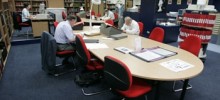
We are not a ‘traditional’ museum with our collections displayed in large galleries. The Royal Mail Archive is available to visit (see Opening Times for our hours of operation), and we have a small display area which you can see for free.
Our large museum collection is currently in storage, and it can be seen by the public on special open days, afternoons and evenings at our Museum Store. See What’s On for the latest dates.
What’s the Museum Store, and what can I see there?
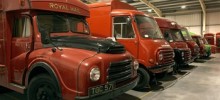
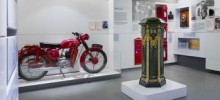
The Museum Store houses objects ranging from the desk of Rowland Hill (founder of the Penny Post), to Post Office vehicles, and an astounding assortment of letter boxes.
The collection of objects in the store is growing all the time as we continue to gather material from the many areas of work in Royal Mail Group, and those in other UK postal operators.
We ask all our guests to remember that it is a working store, rather than a museum designed for everyday public use. Objects here are in storage and do not generally have captions, signage and explanatory text, and it is for this reason that we offer regular curator-led tours of the Store to help visitors get the most from their visit. As it’s a working Store things are often moved in and out for exhibitions or conservation work and so it is not always possible to guarantee certain objects will be available on particular days.
There is a shop at the Store, but no café, although we provide complimentary light refreshments on our tours.
How can I visit the Museum Store?
The Museum Store is situated on the Debden Industrial Estate in Debden, Essex and is open for visitors on a pre-booking arrangement on selected days throughout the year. The Store is also open for special events each year, and from time to time for private tours by groups. For details of scheduled tours please visit our Events pages.
Is the Museum Store accessible?
The Museum Store is wheelchair accessible. A fully accessible toilet with support rails is available onsite.
Can I conduct research at the Museum Store?
Those wanting to access the collections for study are encouraged to contact the Curatorial team to arrange an appointment and discuss their requirements.
What is the Museum of the Post Office in the Community?
The Museum of the Post Office in the Community tells the fascinating story of the role postal communications has played in Britain.
The Museum is located on the first floor of the Post Office within Blists Hill Victorian Town, near Telford, Shropshire. Blists Hill is one of ten Ironbridge Gorge Museums.
We were also involved in the development of the Blists Hill Post Office, a recreation of a typical Shropshire village post office of the late Victorian era. The Blists Hill Post Office is staffed by a Postmaster and a Postman, and basic posting facilities are available.
Find out more about the our museum at Blists Hill, including travel directions, opening hours, facilities and access arrangements.