

Conflict
In wartime, one of the most important means of maintaining troops' morale is provision of an efficient mail service. Letters from family and loved ones at home are eagerly awaited, as is news from the front to those at home. In World War I this was the job of the Army Postal Service. 300 members travelled with the British Expeditionary Force to France in August 1914. By the end of the war this had grown to nearly 4,000 across all spheres of conflict.
The Post Office encouraged staff to enlist in the forces and 75,000 postal staff left their jobs to serve in World War I. 12,000 of these served in the Post Office's own battalions, the Post Office Rifles, and they fought and died bravely on the Western Front, one gaining a Victoria Cross.
In Ireland, the Easter Rising of April 1916 resulted in the destruction of the newly renovated GPO building in Dublin.
Conflict in peacetime took the form of strikes and protests. Protests by suffragettes disrupted postal services and transport strikes delayed the mail and gave rise to temporary express airmail services.
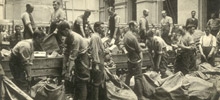
Mail Arriving at the Railhead
(below left) At the outbreak of war, all mails for units serving on the Western Front were sent to the Overseas Base Post Office, initially established at le Havre, where they were sorted.
Letters and parcels were then taken by rail to the Advanced Base Office near the front. At the railheads, the mail was transferred to supply trucks, which transported them to the troops.
By February 1915 all letter sorting was carried out at the Home Depot in London. This substantially shortened the delivery times. Mail that had taken an average of four days could sometimes be received the same day.
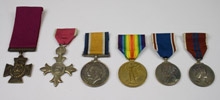
Sergeant Alfred Knight's medals
(below centre) The Victoria Cross and other medals won by Sergeant Knight of the Post Office Rifles.
Catalogue Reference: OB 1997.211 BPMA
Post Office closed during the Easter Rising
(below right) A post office and savings bank closed during the Easter Rising, until 'law and order is fully restored'. Dublin, 1916.
- Illustrations

Mail Arriving at the Railhead
Sergeant Alfred Knight's medals
Post Office closed during Easter Rising


You may also be interested in...
GPO Staff in 1916

Self-respect and a little extra leave - a book on the Easter Rising
Stephen Ferguson examines the events of the Easter Rising from the unique perspective of GPO staff.
Military Medals
We care for nearly 200 military medals awarded to Post Office employees
Our collection spans the Crimean War to the Second World War, with many medals awarded during the First World War.
World War 1
The impact of the Great War on the UK postal service
The Post Office played a vital role in communications during the conflict, despite the chronic lack of staff.


