



Services for disabled people
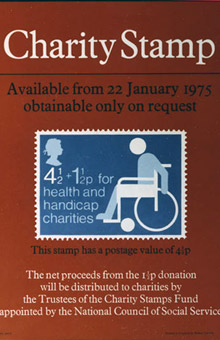
Poster for charity stamp in aid of Health and Disabled Charities, 1975 (POST 110/478)
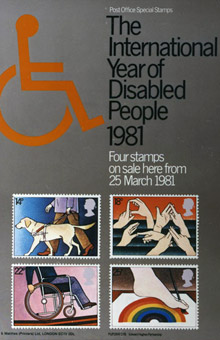
Poster for the International Year of Disabled People stamp issue, 1981 (POST 110/624)

Charity stamp
Year of the Disabled stamps


As a public service organisation the Post Office provides a range of services for disabled people. In some cases this involves separate services catering specifically for the needs of disabled people. One such service is 'Articles for the Blind'. This service was first introduced in 1906 because Braille and large print literature was heavier and thus more expensive to send. Initially it offered reduced rates of inland postage for papers, periodicals and books impressed in Braille or other special type for use by blind people. In 1933 the service was extended to cover overseas post. In 1965 the service became free and remains so today (2011).
The Post Office also issued free wireless licences to visually impaired people. Wireless receiving licences were introduced in 1922 and were required to 'install and use a station for receiving wireless signals'. Free licences for blind people were introduced in 1926 after the passing of the Wireless Telegraphy (Blind Persons Facilities) Act. Television licences were introduced in June 1946 and in 1955 an agreement was reached to issue television licences at a reduced rate to blind people. Today 'blind and severely sight impaired' people continue to be eligible for a 50% discount on their television licence, although broadcasting is no longer the responsibility of the Post Office.
The Post Office has also needed to provide services to individuals suffering from mental illness. The archive includes discussions over the treatment of deposits in the Post Office Savings Bank and whether these could be withdrawn by individuals other than the named account holder. This issue first occurred in 1881 when enquiries were raised as to whether the spouse of an account holder, who was a patient in a mental asylum, could withdraw funds to pay for the account holder's maintenance. Post Office Regulation 22 issued in August 1861 stated 'that if any depositor shall become insane or otherwise incapacitated to act and the same shall be proved to the satisfaction of the Postmaster General and if the Postmaster General shall be satisfied of the urgency of the case he may authorize payment from time to time out of the funds of such a depositor to any person whom he shall judge proper and the receipt of such a person shall be a good discharge for the same.' (POST 30/420a). However, in 1882 concerns were raised regarding the right of the Postmaster General to 'dispose of the property of Lunatics, without the sanction of the Lord Chancellor, to whom the charge of their persons and property is entrusted by law' (POST 30/420a). Further legal discussions ensued, but the right of the Postmaster General to allow such payments was upheld as long as certain conditions were met. These included the provision of a medical certificate testifying to the condition of the depositor, details of a third party prepared to testify to the circumstances of the case in front of a Justice of the Peace, and limitations on the amount allowed to be withdrawn if there was any prospect of the depositor recovering. Similar arrangements were implemented by the Money Order Office in the 1920s to deal with claims for war savings certificates purchased by individuals who later became mentally ill.
Another issue around customers suffering from mental illness relates to the redirection of mail. Clearly if an individual had moved to an asylum they may not be in a position to authorise the redirection of their mail. However the Post Office's usual position was only to allow redirection to be authorised by the named addressee. In these circumstances the Post Office required the redirection to be authorised by a receiver appointed by the 'Masters of Lunacy'. This differs from the situation regarding savings bank deposits and war certificates where claimants were only required to apply to the 'Masters of Lunacy' to be appointed as a receiver if there were other assets beyond those lodged in the Post Office.
In recent times the Post Office has also sought to make the counter side of its operations more accessible. This began in the late 1980s and early 1990s with a major maintenance and refurbishment programme which included accessibility for disabled persons as a high priority. By 1992 level access or ramps had been installed in 770 high street post offices. Also in 1992 the Sittingbourne, Kent Postbus became the first to incorporate a hoist for wheelchair users. There have been two stamp issues relating to the subject of disability. The first was in 1975 and was the first charity stamp issued by Royal Mail. The price of the stamp included a surcharge which benefitted charities for health and disability. In 1981, as part of the International Year of Disabled People, four stamps were issued depicting various types of disability. The passing of the 2005 Disability Discrimination Act has increased the legal requirements on businesses to make reasonable adjustments for the employment of disabled people and for serving disabled customers. However the files in the archive reflect the efforts of the Post Office to address these issues for a long time prior to the passing of the Act.
N.B. Please note that the language used to refer to various disabilities has changed over the centuries. The documents in the archive include the terms used at the time they were written, some of which may be regarded as offensive today. These should be viewed in their historical context.
Sources
POST 30: Post Office Registered Files, Minuted Papers (England and Wales)
POST 92: Annual Reports-especially useful for charting attitudes in the 1980s and 1990s
POST 110: Posters, including posters for disability related stamp issues


You may also be interested in...
Disabled Postal Workers

The history of disabled workers in the Post Office
Looking at the gradual shift from a narrow view of disability in the workplace to employment on an equal footing.
GPO Staff in 1916

Self-respect and a little extra leave - a book on the Easter Rising
Stephen Ferguson examines the events of the Easter Rising from the unique perspective of GPO staff.


