Key Dates
Throughout the centuries, the basic practice of a messenger carrying mail from sender to recipient has remained virtually unchanged.
The Romans brought a messenger system to Britain and built a number of roads around the country. After the Norman invasion in 1066, the postal system gradually developed. It used the existing Roman roads and letters were delivered on horseback. With the growth of towns and cities, the establishment of trading links and the conduct of governance throughout the centuries, communication became increasingly important. The networks of roads, postal routes and coaching inns grew.
When Charles I opened up his ‘royal mail’ for use by the public in 1635, he laid the foundations for the Post Office as an institution. Oliver Cromwell established the General Post Office in 1657 and after the Restoration, Charles II authorised the General Post Office to operate the ‘royal mail’.
The beginning of uniform penny postage in 1840 made sending mail affordable to all for the first time. The development of the telegraph meant a new form of communication, which the Post Office was given control of in 1870. By 1912, it had added the telephone service to its operations and thus held a near-monopoly on communication methods.
In more recent years, Royal Mail has undergone a number of organisational changes, becoming a corporation in 1969 and a separate company from British Telecom in 1981.
Highly significant changes in the history of the postal service took place in 2006. After Royal Mail had held the monopoly for almost 400 years, the postal service was opened to allow other providers to deliver mail. The introduction of the 'pricing in proportion' scheme later in the year also ended the long-standing practice of charging postage solely according to weight. This last innovation represents the latest example of the postal service responding to changing times.
| Events in Postal History |
Date | National & International Events |
|---|---|---|
| 43
|
The Romans begin constructing roads in Britain |
|
| As the Romans enter Britain, they introduce their established system of carrying letters. Letters are carried from the sender to the recipient by a messenger who ensures the safe delivery of the letters. | Roman Britain
|
The Roman road building project nears completion in 81. Roads connect Devon, East Anglia, Wales and Carlisle with South-Eastern England. |
| back to top |
||
|
122
|
Emperor Hadrian visits Britain. He orders the construction of a coast-to-coast wall in Northern England to mark and protect the northern frontier of Roman rule in Britain. 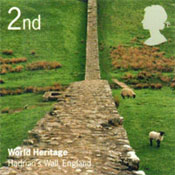 |
|
| 130
|
Construction of Hadrian's Wall is completed. | |
| The Theosian Code mentions overnight shelters spaced at 12-mile intervals which provide accommodation for messengers. | Third Century
|
|
| 1066
|
William of Normandy is victorious in the Battle of Hastings and becomes King of England | |
| back to top |
||
It is estimated that between 1100 and 1135, an average of 4,500 letters per year are sent by Henry I's Exchequer. Royal messengers convey these letters to their recipients via paths in existence since the Romans. |
1100
|
|
| Richard I becomes King. With this, the practice begins of dating letters according to the number of years a monarch has ruled. Actual dates, as previously, often remain unknown: the lack of calendars and newspapers make knowing the actual date much more complex. Envelopes are not yet used and instead letters are fastened with ties to secure them whilst in transit. |
1189
|
|
| With the Chancery and the Exchequer now settled in Westminster, communication with the King when he holds court around the country is by royal messenger. These messengers also transport money around the country between royal departments. Approximately 8 messengers are employed to deliver messages between the King and 20 sherrifdoms distributed across 37 counties. Sherrifs and bailiffs also have their own local messengers who also charge a fee for the delivery of private documents and thus act as 'postmen' for the public. However, only the landowning rich are able to read and write. |
1200
|
|
| At the end of King John's reign, there are fifteen or sixteen royal messengers delivering messages on horseback. Each royal messenger has a specified, regular route, with established rest areas and overnight accommodation. The numbers of messengers employed, both by royal departments and locally, change according to circumstances such as war and available funds. |
1216
|
|
| mid 1200s
|
The earliest spectacles are developed and aid those affected by poor eyesight. | |
| The network of inns and horses available for hire along messengers' routes continues to grow. Several roads emanate out from London and lead to places such as Norwich, Cornwall, Bristol, Haverfordwest, Chester, York, Guisborough and Carlisle. |
1300s
|
|
| A 'newsletter' is developed during the Hundred Years War to keep nobles informed of events. |
1337
|
The Hundred Years War, a series of battles between the English and the French, begins. |
| The Exchequer becomes directly responsible for the expenses of the royal messenger system, a situation which remains in place until the end of the century. The process of communicating between royal departments and Parliament needs to be as efficient as possible, particularly because a number of departments often have to be consulted before any one decision is made. Messengers travelling near to London are paid twopence per day and those travelling around the rest of the country are allocated 20 pence for an eight-day trip. |
1342
|
|
1347-51
|
The Black Death causes widespread mortality in Europe. | |
| Richard II signs his name on a letter. This is the first known use of a royal signature; before this, the wax seal has lent authority to royal letters. | 1386
|
|
Richard II issues a Statute to against those who impersonate royal messengers. |
c.1390
|
|
Paper becomes more widely available and as it is cheaper than both vellum and parchment, letter writing becomes more possible for the literate members of the population. |
Early 1400s
|
|
Surviving letters reveal that personal correspondence is becoming commonplace amongst the gentry and merchant classes, who are able to read and write. English, rather than Latin or French, begins to be used more widely for official documents. |
c.1450
|
|
1476
|
William Caxton opens his printing press in London | |
| The Tudor state allows its royal messenger system to be used by private persons. However, it has only one regular route for transporting official documents and this runs between Berwick and Dover. |
1500s
|
|
1505
|
Leonardo paints the Mona Lisa. | |
1509
|
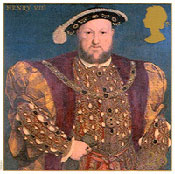
Henry VIII becomes King. | |
| To make it easier to ascertain the authenticity of royal messages, messengers are sometimes given tokens to pass on to the message recipient to provide further proof that the message is genuine. In 1513, for example, Catherine of Aragon sent a piece of the King of Scotland's coat to her husband Henry VIII after the Battle of Flodden Field. |
1513
|
 |
1558
|
Elizabeth I becomes Queen. | |
Legislation is drawn up which states that each Postmaster has to have three horses available for the transporting of mail. 'Posts' are situated at 20-mile intervals and the Postmaster at the next Post must prepare his horses for a changeover on hearing the approaching postboy's whistle. |
1574
|
|
c.1595
|
Shakespeare writes Romeo and Juliet. | |
An increasing population and increasing trade combine with the growing demand from government officials for reform of the postal service. |
Early 1600s
|
|
1605
|
Guy Fawkes and his accomplices plot to blow up the Houses of Parliament. | |
May A Proclamation forbids unofficial letter and packet carriers and gives the State the monopoly over this. Chiefly, the Proclamation aims to ensure that all foreign mails are dealt with by the State. |
1609
|
|
1628
|
William Harvey publishes his discovery that the heart is responsible for pumping blood around the body. |
|
The postal system which does exist is in disarray. A number of postmasters have not been paid their salaries for a number of years; in 1630, they are owed a total of £25,525 10s 2d. |
1630
|
|
Charles I makes the postal service available for the use of his subjects in order to generate revenue without recourse to Parliament. This forms the beginning of the Post Office as we know it today. 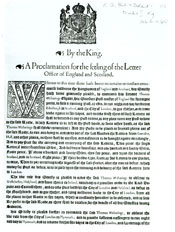 |
1635
|
|
| back to top |
||
1642
|
The English Civil War begins. | |
1649
|
Charles I is beheaded and the Interregnum period begins. | |
1653
|
Oliver Cromwell dissolves Parliament and rules as Lord Protector. | |
Oliver Cromwell establishes the General Post Office. |
1657
|
|
| back to top |
||
Henry Bishop is appointed the first Postmaster General. |
1660
|
Samuel Pepys begins his diary. Charles II, son of Charles I, accepts the throne after Oliver Cromwell's death. Charles has been recognised as King of Sctotland since 1649. |
Henry Bishop develops the first handstamp for use by Post Offices to show when letters had been received into their offices. |
1661
|
|
1665
|
The outbreak of the Great Plague occurs. | |
1666
|
The Great Fire of London destroys 463 acres, or two thirds of the city. |
|
Control of the Post Office is passed from the King's household to the Treasury. It remains controlled by the Treasury until 1969. |
1667
|
|
Robert Murray and William Dockwra develop the London Penny Post for delivering mail across the city. There are six main offices and all postage has to be pre-paid. Items weighinig up to 1lb can be delivered for 1d. Post marks show the time letters are received at an office and same day delivery is guaranteed. |
1680
|
|
An Inland Office report declares the London Penny Post illegal and it is closed down in November. Less than a month later, the government opens its own penny post service in London, very similar to the one it has just declared illegal. |
1682
|
|
1687
|
Isaac Newton publishes his theory of gravity. |
|
1694
|
The Bank of England is founded. | |
One of the first 'cross posts' is established between Bristol and Exeter to connect nearby towns to the main towns. |
1696
|
|
|
1707
|
The Acts of Union between England (which is already united with Wales) and Scotland form the Kingdom of Great Britain, with one Parliament operating from Westminster. |
|
The Post Office Act signals the development of a unified postal system for the newly-unified England, Wales and Scotland. |
1711
|
|
Ralph Allen begins to extend the system of 'cross posts' which serve the towns near the main postal towns. 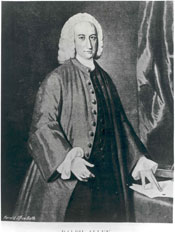 |
1719
|
|
1721
|
Sir Robert Walpole is made Great Britain's first Prime Minister and gradually takes control of the government over the next few years. |
|
Penny Posts are made legal for any other town, city or suburb if the PO thought it 'necessary and convenient'. The Penny Posts include many features of the postal system in future centuries, with a single rate of postage - a penny if sent within the penny post area - calculated by weight. Mail could also be prepaid if the sender chose to. |
1765
|
|
1776
|
The American Declaration of Independence is signed on 4 July. |
|
John Palmer proposes using coach and horses to deliver mail. August 2 The first mail coach journey is made from Bristol to London via Bath overnight and takes 16 hours. Palmer's system requires horses to be changed every ten miles because of the speed at which they travel. 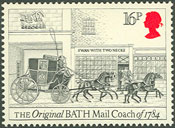 |
1784 |
|
A mail coach service is established in March from London, to Norwich, Liverpool and Leeds. By the end of the year, services have been established to serve cities and towns such as Leeds, Manchester, Liverpool, Portsmouth, Birmingham, Holyhead and Hereford from London. |
1785
|
|
John Palmer is made Comptroller General of the Mails. He establishes a Newspaper Office to improve the process of carrying newspapers, which are carried free of charge around the country. The mailcoach journey from London to Edinburgh can now be made in 60 hours and there is a growing network of provincial mailcoach routes. However, some of these are hampered by the poor condition of the roads. Mail coaches can carry up to four passengers; in later years, two passengers are also carried on the roof of the mailcoach. |
1786
|
|
1789
|
The French Revolutionary Period begins. |
|
Francis Freeling visits Edinburgh and observes the private penny post in the city, which delivers letters and parcels each hour. |
1790
|
|
After Francis Freeling has realised that a government penny post in Edinburgh might be profitable, the official Edinburgh Penny Post is opened. Peter Williamson, the operator of the private penny post is awarded a pension of £25 per year. The Penny Post system now proliferates. Mail weighing up to four ounces can be carried for a penny to an address within the area of each town, or the national rate of postage can be added for delivery of the item to another town. |
1793
|
|
1796
|
Edward Jenner develops a successful vaccination against smallpox. | |
Postage rates are raised over the next 15 years to generate revenue to fight the Napoleonic Wars; the end of the wars does not see the reduction in postal rates. The London Penny Post becomes the London Twopenny Post. Post sent to, and within, outer, 'rural' areas, is charged at 3d. The London Foreign Office has its own delivery area and own offices to handle post coming from abroad. An Act of Parliament makes it legal for villages not currently served by the postal system to establish their own postal system or system of messengers to connect with the nearest post town. |
1801
|
The Act of Union between Great Britain and Ireland comes into effect, forming the United Kingdom of Great Britain and Ireland. |
1815
|
Napoleon is defeated at Waterloo. |
|
1825
|
The world's first steam locomotive railway opens between Stockton and Darlington. William Sturgeon develops the electromagnet, which lays the foundations for future developments in telegraphy. |
|
| The Liverpool-Manchester railway opens. Two months later, the Post Office begins using the railways to convey mail. |
1830
|
American Joseph Henry develops the process of sending an electronic current over a wire which to strike a bell at the other end. This proves what is possible with the transmission of an electronic current. It is another step on the road to the development of the telegraph. |
After recommendations by the commissioners investigating the Post Office, the British and Irish postal systems are reunited. |
1831
|
|
1832
|
The Great Reform Act extends voting rights to middle-class men. | |
The Post Office refuses to extend the 2d postal area in London, even though the distinction between this area and the 'rural' 3d. area is rapidly becoming less than obvious. However, to even out postal provision, the Post Office includes everywhere within twelve miles of the GPO headquarters in the threepenny post. |
1834
|
|
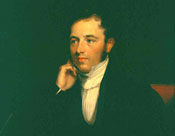 Rowland Hill publishes Post Office Reform: Its Importance and Practicability. The Select Committee on Postal Reform is established and produces two preliminary reports in the following year. |
1837
|
Cooke and Wheatstone exhibit the 'five needle telegraph' which becomes widely used for railway signalling. The process is too long and cumbersome to be used for the telegraphic transmission of lengthy and more complicated messages.
Queen Victoria's reign begins.
|
Travelling Post Offices, which make use of the railways, are introduced. Mail can now be sorted whilst on the way to its destination. As the railway network expands, so do the Travelling Post Offices. 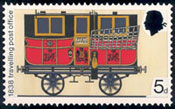 After operating semi-officially since the 1790s as a secure way for money to be transmiited via the mail, the Money Order Office becomes an official service of the Post Office. A charge is made for the service, which becomes cheaper when the Penny Post is introduced. |
1838
|
The various railways around the country are joined together. London and Preston, for example, are now linked by rail. |
The Postage Act is passed. This gives the Treasury powers until October 1840 to make arrangements for the introduction of a universal penny postage system. 5 December: Uniform 4d. postage is introduced as an interim measure. |
1839
|
|
January Uniform Penny Post is approved. Mail can now be delivered for the cost of a penny by the sender, regardless of the distance to be travelled. This makes posting letters affordable for all for the first time. Letters do not have to be pre-paid, but cost the recipient double the postage rate if they are not pre-paid. May The first postage stamps are issued. These are, most famously, the Penny Black, the Twopenny Blue, and the Mulready, an envelope upon which the postage rate is stamped. 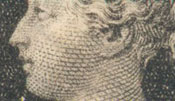 |
1840
|
Samuel Morse and Alfred Vail patent Morse Code, their system of dots and dashes to represent each letter of the alphabet. The first morse code message is not sent for another four years, however. |
| back to top |
||
1841
|
Cooke and Whetstone's 'needle telegraph' is put on public display and members of the public are able to transmit messages to each other. |
|
1843
|
The world's first Christmas card is sent. It is commissioned by Henry Cole, a civil servant who worked for Rowland Hill. 1,000 copies of the design are printed, allowing Cole to send as many as he needs and sell the remaining ones for sixpence each. The cards are priced out of the financial means of many, however. 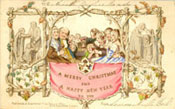 |
|
1844
|
Samuel Morse transmits the first message in morse code on his new telegraphic system from Washington D.C. to Baltimore in the USA on 24 May, thus inaugurating an important new system of communication. |
|
With the arrival of the railways and the opportunities for quicker mail delivery that they afford, the last London-based mail coach makes its final journey. Horses are still used for mail delivery in certain areas of the country, however. |
1846
|
|
1848
|
Karl Marx publishes the Communist Manifesto. | |
Changes in the availability of stamps mean it is no longer necessary to go to a Post Office to send a letter: stamps can be purchased and saved until they are needed. This also makes it possible to have boxes in the street into which people can deposit letters they wish to send. Anthony Trollope, the novelist and Postmaster, experiments with pillar boxes (post boxes) in Jersey. |
1852
|
|
| Anthony Trollope's pillar box scheme is extended to the mainland. |
1853
|
|
Six pillar boxes are now available in London for the posting of letters. |
1855
|
|
Rowland Hill proposes a system of dividing London into ten postal districts to speed up the delivery of mail within the city. The districts are based on directions on a compass and customers are asked to write the postal district code - EC for East Central, for example - when sending mail. |
1856
|
|
Delivery of letters to people's houses is currently not always free of charge. Free delivery depends on population size and proximity to an existing post town. However, by 1859, 93% of letters sent are not subject to a delivery charge. |
1859
|
Charles Darwin publishes The Origin of Species. |
September The Post Office Savings Bank is opened for customer business. |
1861
|
|
1867
|
The Representation of the People Act enfranchises some working class men. |
|
An Act of Parliament gives control of the Telegraph Service to the Post Office. Customers can now go to a Post Office to send telegrams. The acquisition of the telegraph service means that the Post Office now has a numerically significant female workforce. The Post Office issues postcards, which can be sent for ½d. The postage rate is imprinted on the cards. 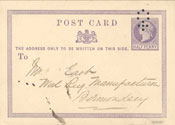 |
1870
|
|
| back to top |
||
Women are permitted to work, under supervision, in the Returned Letter Office. |
1873
|
|
Women clerks are employed in the Post Office Savings Bank for the first time. |
1874
|
|
The Post Office imposes a 'marriage bar', meaning that married women cannot apply for work at the Post Office and that single women employees have to resign from their positions when they get married. |
1875
|
|
| Tricylces are first used to deliver the mail in Coventry. | 1880
|
|
The Post Office introduces the Parcels Post. |
1883
|
|
1884
|
The Representation of the People Act gives the vote to larger numbers of working class men in England and Wales. Greenwich, London, is established as 0 degrees longitude. |
|
| The Post Office re-introduces a horse-drawn mail service to use in conjunction with the transport of mail on the railways. | 1887
|
Arthur Conan Doyle publishes the first Sherlock Holmes story. |
Telegrams are now delivered free within a radius of 3 miles, rather than the previous 1 mile. Bicycles are purchased for use by postmen and boy messengers. The Post Office also trials the use of a steam powered van for delivery of mail. |
1897
|
|
| The Post Office experiments with petrol-powered vehicles for mail delivery. | 1898
|
|
| There are now 32,593 pillar boxes in the United Kingdom. | 1900
|
|
| The newly-introduced state pensions are paid from Post Offices. | 1908
|
The first state pensions are introduced in Britain. |
In celebration of the coronation of George V, an airmail flight operates between Hendon and Windsor. 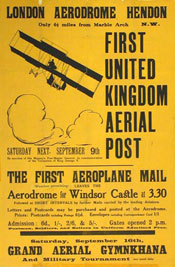 |
1911
|
|
The Post Office acquires full control of the telephone system from the National Telephone Company. The female workforce increases again as National Telephone Company staff gradually join the GPO. |
1912
|
|
| back to top |
||
The number of Post Office staff reaches a peak of 249,696 after amalgamation with the telephone service. Staff levels are not this high again until 1936. |
1913-1914 | |
After having previously contracted out the service, the Post Office begins planning its own vehicle fleet and purchases a small number of vehicles in order to begin trials. November After the interception of his telegrams by British officials, Carl Hans Lody is executed at the Tower of London for espionage. He is the first person to be held at the Tower for almost 100 years, the first person to be executed at the Tower for 150 years and the first foreign spy to be executed in Britain. |
1914 |
Britain enters the First World War. 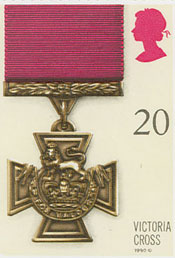 |
| The General Post Office in Dublin is the scene of a siege during the Easter Uprising. |
1916
|
|
Over 19,000 bags of mail per day are sent to the troops in France. In the ten day period before Christmas Day, half a million bags of mail are sent to France. |
1917
|
The February and October Revolutions take place in Russia. |
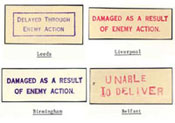
Censorship of mail between Britain and abroad becomes vital during the war. By the final year of the war, 4,861 censors are employed by the War Office. The standard cost of sending a letter is raised from 1d to 1½d due to rising costs, thus ending the Penny Post which had been in existence since 1840. |
1918
|
The First World War ends on 11 November with the signing of the Armistice. The Representation of the People Act enfranchises women over thirty, subject to certain conditions. 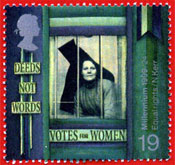 |
| The first publicly-available overseas airmail service operates on 11 November between London and Paris. | 1919
|
|
1922
|
With the emergence of the Irish Free State after the Irish War of Independence, the General Post Office in Ireland is no longer controlled by the GPO in Great Britain. |
|
| The Post Office trials the use of motorcycles for delivering mail. | 1924
|
|
| The Post Office fleet now comprises 1819 vehicles. | 1925
|
|
The Post Office (London) underground railway ('mail rail') opens, running from Paddington station via Mount Pleasant and the King Edward Building to the Eastern District Office, east of Liverpool Street station. |
1927
|
|
1928
|
The Representation of the People Act gives women the vote on the same terms as men. All UK citizens aged 21 and over are now eligible to vote in elections. |
|
1929
|
The Wall Street Crash occurs as the American Stock Exchange crashes. | |
| Blue airmail pillar boxes are erected around the country for mail to be sent abroad via the new airmail service. | 1930
|
|
200 million miles are cycled each by postmen and postwomen delivering mail. Meanwhile, in snowy weather, motorcycles are the only usable form of transport, which also proves their suitability for the fast work of delivering telegrams. 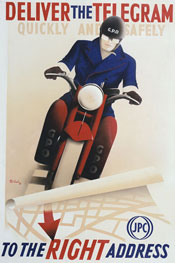 |
1933
|
|
Sir Stephen Tallents is appointed as the first Public Relations Officer of the GPO, bringing with him what is to become the GPO Film Unit (and later the Crown Film Unit). |
1934
|
|
The greetings telegram is introduced. The telegram form is ornately decorated and is delivered in a gold envelope. |
1935
|
|
The GPO Film Unit produces Night Mail, a documentary film about the work of the Travelling Post Office. The GPO also launches the 'speaking clock', enabling users to dial 'T.I.M.' and hear a recorded announcement of the exact time. The recordings feature the voice of Jane Cain, the winner of a nationwide competition to find a suitable voice. September Mobile Post Offices are launched, which are able to travel around the country to events and communities whenever needed. They offer postal, telegraphic and telephone services. |
1936
|
The poet W.H. Auden writes a poem for the film Night Mail and Benjamin Britten writes the musical score. |
15% of GPO staff join the forces in the first week of the war. Bomb-damaged Post Offices are supplemented by 'tented' Post Offices which are transported in Royal Mail vans. In one night in September 1940, 23 London Post Offices are bombed. In December 1940, the Central Telegraph Office is damaged by bombs. Replacement facilities are operating within 48 hours. |
1939
|
The Second World War breaks out in Europe. |
The 'speaking clock' is launched additionally in Liverpool. It complements the London version and also specifically serves the North. |
1942
|
 |
GPO Engineers are instrumental in the building of Colossus, the world's first electronic computer. Colossus is used to break the Nazi Enigma and Lorenz codes and is built by GPO engineers at the GPO research centre at Dolis Hill. It is transferred to Bletchley Park in 1943. |
1943
|
|
1945
|
The Second World War ends in Europe in May and in the Far East and the USA in August. | |
The 'marriage bar' for women employees in the Post Office is removed after having been in place for over 70 years. |
1946
|
|
1948
|
The National Health Service (NHS) is introduced in Britain. | |
| A horse-drawn mail-van is used in London for the last time. | 1949
|
|
23,045 accounts are now held at the Post Office Savings Bank. |
1950
|
|
1952
|
Her Majesty Queen Elizabeth II becomes Queen. |
|
The first modern postal code is introduced in the Norwich area to aid mechanised sorting. |
1959
|
|
| Mopeds are introduced as a trial method for mail delivery. | 1962
|
|
1963
|
Martin Luther King gives his 'I Have A Dream' speech. | |
The Post Office Tower opens in Fitzrovia, London. 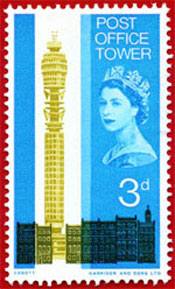 The present system of postcodes is introduced at Croydon and is gradually extended to the rest of the country. |
1966
|
|
The first Royal Mail Post Bus Service begins operating in Llanidloes in mid-Wales. Based around the old idea of mail coaches also carrying passengers, the Post Bus conveys mail but also carries passengers along its route. The service still operates in communities today. |
1967
|
|
Two-tier postage is introduced, giving customers the choice between sending their mail first class or opting for cheaper, but slower, second class delivery. |
1968
|
|
The Post Office gains corporation status, putting it on a par with other nationalised industries. Post Office employees are no longer Civil Servants and the office of Postmaster General, first introduced 306 years ago, no longer exists. |
1969
|
|
| back to top |
||
The first national postal strike is staged, with workers protesting that their standard of living is declining due to insufficient pay levels. |
1971
|
|
The Post Office vehicle fleet reaches its highest level to date, with 33,100 vehicles. |
1972
|
|
October The Post Office and British Telecom begin operating as separate organisations. |
1981
|
|
| back to top |
||
Royal Mail separates its operations into three businesses - Royal Mail letters, Royal Mail Parcels and Post Office Counters. |
1986
|
|
1989
|
The Berlin Wall falls, re-uniting East and West Germany after 28 years of separation. | |
Mobile Post Offices are revived, bringing postal services to communities that otherwise would not have a Post Office. They operate to a specific timetable. |
1996
|
|
As a result of widespread use of email and the telephone, BT relinquishes its telegram service. A private company takes it over, marketing the telegram as a 'retro' or nostalgic method of communication. June After operating for 75 years and conveying between 4 and 12 million items of post per year between Whitechapel and Paddington, Mail Rail, the GPO's underground railway, closes. |
2003
|
|
| The Travelling Post Office (TPO) travels for the last time on January 9, 2004 | 2004
|
|
January The postal service is opened to full competition, meaning that any organisation licensed by Postcomm, the Postal Services Commission, can operate a service in the UK to collect, carry and deliver mail. August Royal Mail introduces its new 'pricing in proportion' scheme. This is the most significant change in postage procedures since the introduction of the penny post and now means that mail is charged according to both weight and the size of the item being sent. |
2006
|
|
| back to top |