


2d Mackennal profile head sheet
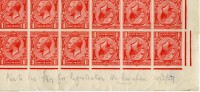
1d Mackennal profile head sheet
Problems were identified with inserting the Downey three-quarter profile head into the existing frames. After much experimentation with engraving and printing, the King decided that the Downey head needed to be replaced and suggested a true profile based on Bertram Mackennal’s effigies for coins and medals. This was then inserted into frames by Mackennal and Eve, producing the Mcakennal profile head issue which replaced the Downey head issue in the second half of 1912.Mackennal’s ‘coinage’ head effigy was used as the basis of the ½d, 1½d, 2d, 3d and 4d values, and the large ‘medal’ head for the 1d and 2½d values. An intermediate version was used for the 5d to 1s values. Mackennal designed the frames for the ½d to 4d denominations whilst Eve designed the frames for the 5d to 8d ‘Pillar’ design and the 9d to 1s ‘Wreath’ design. This profile of George V became his iconic image and stamps were issued from 1912 to 1913. The stamps were printed by Harrison and Sons Ltd, except for the 6d printed in doubly-fugitive ink at Somerset House by the Stamping Department of the Inland Revenue.


